
Inside a Roger Brushless Motor: The Engineering Explained
Inside a Roger Brushless Motor.
The Engineering Explained.
A technical breakdown of the architecture, control system and engineering decisions that make a Roger brushless gate motor genuinely different from everything else on the market.
A Roger operator does not simply open a gate. It is a complete electromechanical system — a permanent-magnet brushless motor driven by a digital controller running Field-Oriented Control, fed by a low-voltage power architecture, and observed in real time through native rotor feedback. The result is an installation that runs cooler, lasts longer, responds faster, and needs less service. This is how it works.
The Architecture Tells You Everything
Before discussing the motor itself, the power architecture has to be understood. It is where most operators on the market take their first wrong turn — and where Roger takes a fundamentally different path.
Runs full mains voltage directly into the motor. Hot, noisy, brush-wearing, service-heavy. Cannot run on backup battery.
Safer than 230V and battery-capable, but still has carbon brushes that wear, arc, and require scheduled replacement.
Low-voltage three-phase AC into a permanent-magnet brushless motor under digital MOSFET control. No brushes, no relays, no compromise.
Mains-powered operators put 230V directly across the windings. Everything that happens after that — the heat, the noise, the brush wear, the inability to run on battery backup — is a consequence of that one architectural choice.
Low-voltage brushed operators step the voltage down to 24V DC. Much better. Safer, quieter, battery-friendly. But the brushes are still there, still arcing, still wearing.
Roger takes the next step. The mains is transformed down to a low-voltage AC supply, then rebuilt by a four-quadrant MOSFET inverter into a clean three-phase waveform feeding a permanent-magnet brushless motor. No brushes anywhere in the system.
The inverter is the key. It is not simply switching power on and off — it is actively shaping a three-phase waveform, controlling current and voltage at thousands of times per second to produce smooth, precise torque from a motor with no mechanical commutation at all.
Three Phases, a Permanent Magnet, and No Brushes
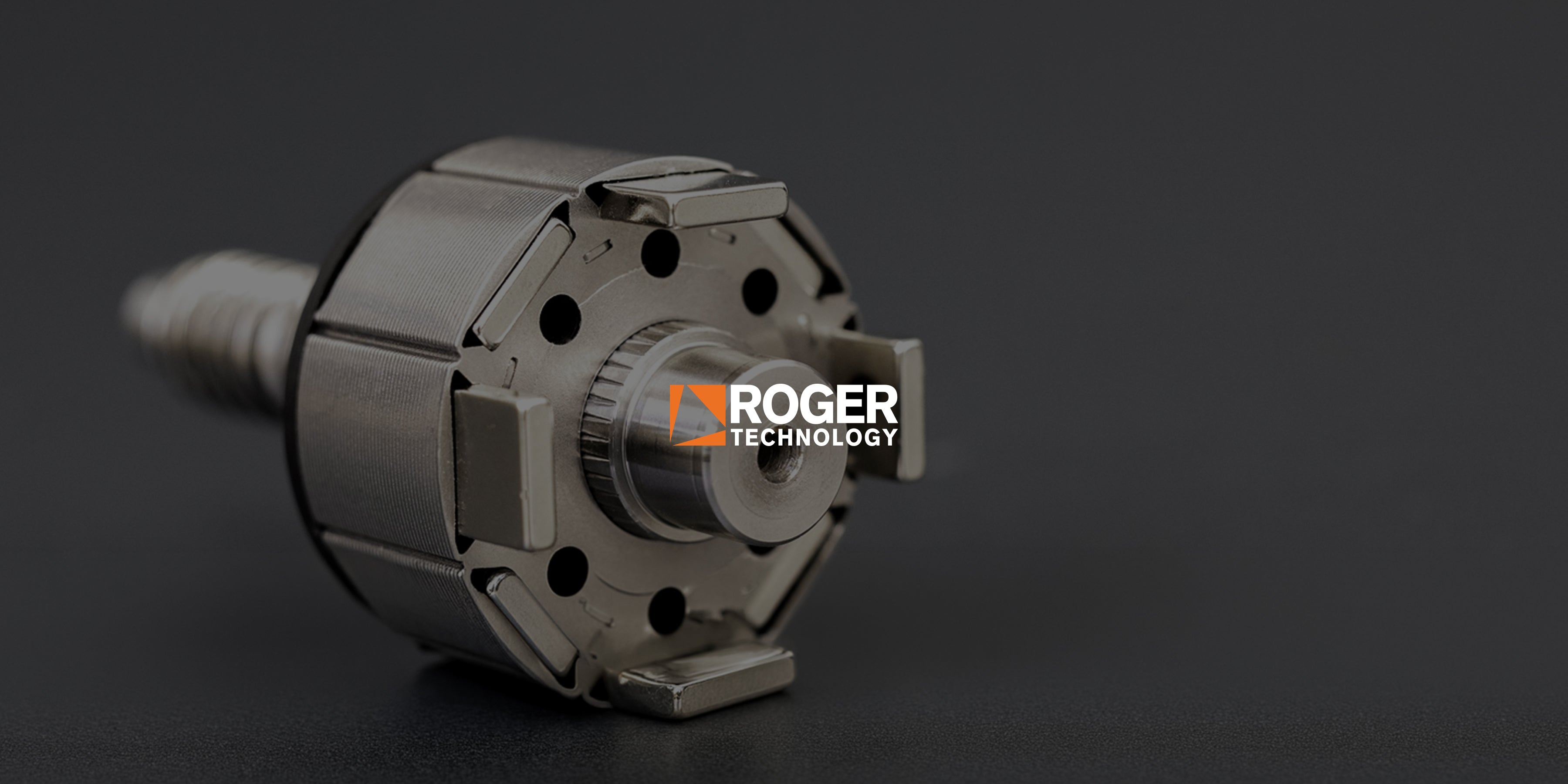
Inside every Roger brushless operator is a three-phase synchronous motor with a permanent-magnet rotor. The windings are concentrated coils — wound directly around the stator teeth rather than distributed through slots — which gives a higher copper fill, less wasted space, and a more efficient magnetic circuit.
There are no brushes. There is no commutator. There is no mechanical contact carrying current to the rotor. The rotor spins inside the stator as a permanent magnet, pulled around by a rotating magnetic field created entirely by the controller. Wear, friction, sparking and dust generation in the electrical path are eliminated by design.

No brushes means no scheduled brush replacement, no carbon dust contamination, no commutator resurfacing, and no electrical arcing. The motor's electrical service life is, in practical terms, the life of its bearings.
Neodymium. The “Super Magnets.”
The rotor is fitted with neodymium-iron-boron magnets — the strongest commercially available permanent magnets in the world. Compared with the ferrite magnets used in cheaper operators, neodymium delivers dramatically higher magnetic flux density in a much smaller package.
A smaller, lighter rotor means less inertia. The motor accelerates and decelerates faster, which makes obstacle detection more responsive and motion control smoother.
Magnetic strength remains essentially constant over the gate's service life — the motor delivers the same torque on day 7,000 as it does on day one.
Combined with the precision-wound stator, the result is a motor that is compact, torque-dense, and electrically efficient — converting more of its input power into actual mechanical work at the gate.

The Digital Controller — 100% Digital, Not Analogue
Every Roger brushless operator is driven by a fully digital controller. A 40 MIPS microcontroller runs the entire system — power conversion, motor control, feedback interpretation, safety logic and diagnostics — without a single mechanical relay or analogue trimpot in the power path.
The output stage is a four-quadrant MOSFET inverter. Four-quadrant means it can drive the motor in both directions and brake it electronically in both directions — actively decelerating the gate by feeding energy back through the bridge rather than letting mechanical resistance absorb it.
There are no traditional relays switching the motor windings. Everything happens in silicon, at PWM frequencies far above the audible range, with current shaped in software.
The same control strategy used in electric vehicles and industrial servos.
FOC mathematically decouples the motor's torque-producing current from its magnetising current and controls each independently. The controller knows where the rotor is at every instant and applies exactly the right current vector to produce the torque it wants — no more, no less. The result is precise torque control across the entire speed range, near-silent operation, and the ability to detect a very small change in load almost immediately.
“The motor is not simply powered. It is measured, calculated, and controlled — thousands of times per second.”
How the Controller Reads the Rotor
A brushless motor needs to know where its rotor is at every moment. Roger achieves this two ways depending on the operator family.
Sensorless — native back-EMF encoder
In sensorless configurations, the controller infers rotor position from the back-EMF generated by the spinning magnets themselves. The motor becomes its own encoder. No extra sensors, no extra wiring — the same three motor wires carry both power and position information.
No hall sensors. No encoder cable. No additional terminals. The same three conductors that drive the motor also report its position.
Sensored — 4,096 PPR magnetic encoder
Where higher precision is required, Roger fits a contactless magnetic encoder delivering 4,096 pulses per revolution. That works out to angular resolution finer than 0.1°. The controller knows the gate's position to within a fraction of a millimetre at the leaf.
In both configurations the result is complete digital visibility of what the motor is doing — speed, position, current, torque, and load — at all times. The controller is never guessing.
The Engineering, On Site
All of the above architecture exists for a reason. On the gate, in service, every day, it produces four very specific outcomes.
Low-voltage operation and high electrical efficiency mean the motor runs cool. Insulation, bearings and electronics all benefit, extending service life.
FOC sees the smallest change in load current almost immediately. The gate reacts to an obstruction with less force and less delay than a brushed motor can mechanically achieve.
Higher efficiency means more open-close cycles per amp-hour of battery — critical during a mains outage at a busy site.
No brushes to replace. No commutator to dress. Routine electrical maintenance on the motor itself effectively disappears from the maintenance schedule.
We Distribute Engineering, Not Motors.
Before we brought Roger Technology into the Edgesmith range, our team visited the factory in Mogliano Veneto and walked the production line — from raw stator laminations through to final QA. We wanted to see, with our own eyes, how the motors are designed, wound, magnetised, programmed and tested.
What we found is what this article describes: a manufacturer that has made deliberate engineering choices — low-voltage three-phase architecture, neodymium magnets, full digital FOC control, native rotor feedback — instead of cost-cutting ones. That is the reason these operators behave the way they do on site.
We don't simply resell a brand. We choose components we can stand behind technically, and we explain them properly so installers and specifiers can make informed decisions.
— The Edgesmith Team