
Article: Native Backup: Why Roger on Solar Just Works
Native Backup: Why Roger on Solar Just Works
Native Backup.
Why Roger on Solar Just Works.
How Roger's low-voltage DC-bus architecture makes battery operation the controller's default state rather than a bolted-on fallback — and what that means for cycle counts, solar specification and site selection.
Battery backup on a conventional gate operator is an addition. Battery backup on a Roger is the controller's normal operating mode interrupted by the convenience of mains. The distinction is architectural, not promotional — and it's what makes the difference between a backup system that delivers a couple of emergency cycles and one that runs through a multi-day outage without the customer noticing.
Backup Added to a Mains-Native Design
A 230V AC gate operator is engineered around mains input. The motor is designed to run on 230V AC. The controller expects 230V AC at its input terminals. Battery backup, where fitted, is added by four components.
Every conversion stage costs efficiency. The inverter itself draws standby current — often 5–15 watts continuously, which adds up to a meaningful drain over days. The operator, when it runs on inverter power, draws its full mains-side current, just produced by the battery instead of the grid.
It works. It's also the maximum performance available from a mains-native operator running on a battery-and-inverter workaround. Cycle counts on backup are modest, and solar specification has to size against the inverter losses as much as against the operator load itself.
The Battery Sits on the Bus
The Roger brushless architecture is low-voltage from the start. The full power chain on a 24V or 36V Roger runs: mains in → transformer → low-voltage AC bus → rectifier → DC bus → MOSFET inverter → motor.
The DC bus in the middle of that chain is the controller's working supply. Everything downstream — the inverter, the motor, the position feedback, the obstacle detection — runs from the bus.
An inverter steps battery DC back up to 230V AC, and a transfer mechanism switches the operator's input from mains to inverter output. The inverter itself draws standby current.
A backup battery is connected directly to the DC bus. There is no inverter stage between battery and operator.
When mains is present, the bus is fed from the transformer-rectifier chain and the battery floats on the bus, topped up by the charge controller. When mains drops, the battery feeds the bus directly. The transition is seamless — there is no AC-to-DC-to-AC conversion in the path.
“Battery operation is the controller's normal state. Mains is the source that makes the bus convenient to feed long-term.”
The architecture doesn't switch modes when the grid drops — it just continues running from the same DC bus, now supplied entirely by the battery.
Under 30W at Running Speed
The Roger brushless motor is electrically efficient by design: a permanent-magnet synchronous machine running on three-phase sinusoidal excitation.
On the load side, the published numbers are striking: a 600kg sliding gate moves on under 30W of continuous power draw at running speed. A swing gate operator's running consumption is even lower.
Combined with the absence of inverter losses on the source side, a modest backup battery delivers a high cycle count through a mains outage.
A single solar panel can comfortably keep the battery topped up over an unattended week of normal operation.

No Inverter to Size
The complication in specifying solar for a conventional gate operator is the inverter. Sizing has to allow for inverter standby load (continuous, even when the gate isn't operating), inverter conversion efficiency (typically 85–92%), and the operator's full mains-side current during operation. A meaningful proportion of the solar budget goes to feeding losses rather than moving the gate.
On a Roger, the chain is direct.
What the panel produces either goes into the battery or directly into the load. No inverter standby drain, no inverter conversion losses, no inverter sizing to worry about.
This makes Roger installations on solar genuinely simple to specify. The Edgesmith team works with installers to size panel and battery against a known low-watt load, not a load inflated by inverter overhead.
Where Mains to the Gate Is Impractical
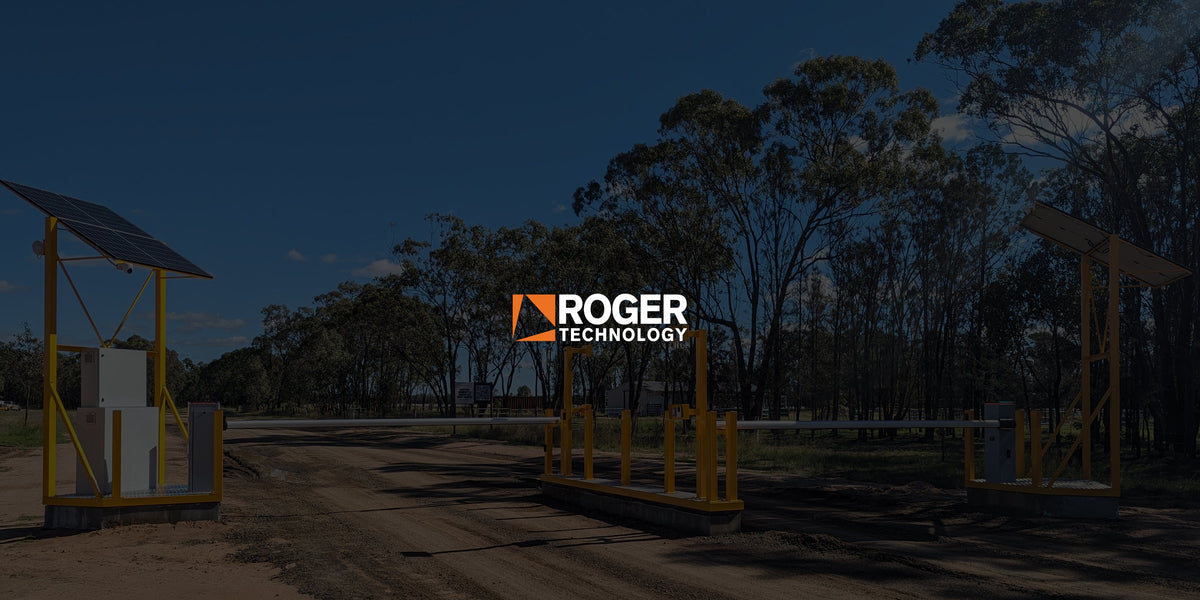
The practical consequence of native low-voltage operation is that sites where running mains to the gate is impractical become straightforward Roger installations.
A solar Roger isn't a compromised version of a mains Roger; it's the same controller running from its normal DC bus, fed by a different upstream source.
Backup You Can Stand Behind
No inverter to size, no inverter standby loss to compensate for, no transfer switch to specify. Specification is panel, battery, controller, motor.
Cycle counts on battery genuinely correspond to what the customer experiences in an outage. Marketing the backup capability becomes a description of what the system does, not a hopeful estimate.
Sites in storm-prone or fire-prone regions can be quoted with backup that the installer can stand behind on technical grounds, not just optimistic ones.
Properties that previously required mains-to-gate trenching can be quoted as standard Roger installations on solar. The addressable installation base expands.
Mains as a Convenience
The conventional approach treats battery as a backup for a mains-powered operator. Roger treats mains as a convenience for a battery-capable controller. The two architectures behave very differently when the grid drops — and they specify very differently when solar is the primary source.
A Roger on solar isn't a mains operator with batteries strapped on. It's a controller working in its natural operating mode, fed by the source that suits the site.
Where the Power Isn't.
Some of the hardest quotes in gate automation are the ones where the power isn't where the gate is. A long driveway, a rural block, a coastal boundary — the conversation has tended to start with the cost of getting mains to the gate.
This architecture changes where that conversation starts. When the controller already runs from a DC bus, solar isn't a workaround to be justified — it's another way of feeding the same system.
We don't simply resell a brand. We choose components we can stand behind technically, and we explain them properly so installers and specifiers can make informed decisions. We distribute engineering, not motors.
— The Edgesmith Team
Part 08 — The Quote Stage Conversation. What to say when the customer asks why a Roger costs more than the other quote — eight technical answers drawn from the engineering this series has covered.